Anti-Cheat Software Is Moving Into Single-Player Games, And Players Are Pushing Back
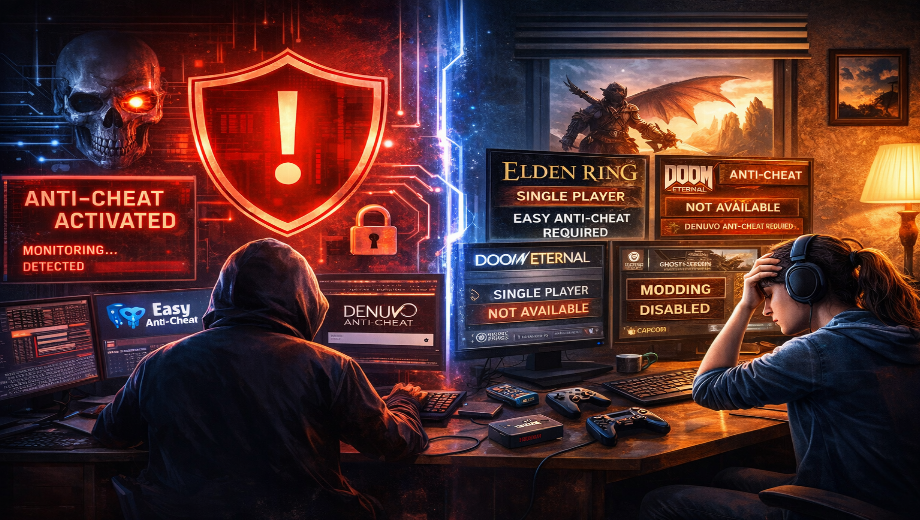
Anti-cheat technology is no longer limited to competitive multiplayer games. Publishers increasingly deploy these systems inside single-player PC titles to control progression, block save manipulation, and enforce online requirements. This shift has triggered growing backlash from PC players and modding communities, who argue that such measures undermine the freedom traditionally associated with solo play.
Single-Player Games Are No Longer Treated as Offline
One of the most visible examples involves Easy Anti-Cheat in Elden Ring, developed by FromSoftware and published by Bandai Namco. Even when players choose to play offline, the anti-cheat system still runs in the background, blocking many mods and trainers by default. As PC Gamer reports, players often disable the software manually to regain mod functionality, highlighting how deeply embedded the system has become.
This approach reflects a broader shift in how publishers define single-player experiences. Games increasingly rely on online authentication, shared progression systems, and backend validation, even when no competitive play is involved.
Doom Eternal Set the Precedent
The debate intensified when id Software added Denuvo Anti-Cheat to Doom Eternal, a game that focuses heavily on single-player content. Bethesda released the update despite immediate concern from players, who reported performance drops and objected to the kernel-level access required by the software.
According to The Verge, the backlash forced id Software to later remove Denuvo Anti-Cheat from single-player modes. The incident became an early reference point for players opposing similar systems in later games.
Capcom and Ubisoft Expand Protection Systems
Capcom faced criticism after adding new DRM and protection layers to older PC releases, with players reporting broken mods and performance issues. Reporting from PC Gamer shows how these changes affected games that had worked without issue for years.
Ubisoft has also drawn scrutiny for requiring persistent online connections in titles like Ghost Recon Breakpoint, even during solo play. The publisher argues that shared progression and backend services justify the requirement, but many players reject that explanation.
Why Publishers Defend Anti-Cheat in Solo Games
Publishers argue that modern single-player games rarely operate in isolation. Cloud saves, live updates, shared economies, and cross-platform progression blur the line between offline and online play. From this perspective, anti-cheat tools protect backend systems from manipulation and ensure consistency across platforms.
However, as IGN notes, players increasingly question why deep system-level software is necessary when no competitive fairness is involved.
Mods, Trainers, and Player Freedom
For PC players, the impact is immediate. Anti-cheat systems frequently break mods, trainers, and accessibility tools, even when used offline. Quality-of-life modifications and difficulty adjustments often trigger false positives, limiting customization in games meant to be played alone.
As publishers continue to blur the boundary between single-player and live-service design, anti-cheat software is becoming a permanent fixture in more PC games. Unless studios draw clearer limits, the tension between player freedom and publisher control will only intensify.

- Secure Software (Virus checked, GDPR-compliant)
- Easy to use: get ready in less than 5 min
- More than 5300+ supported Games
- +1000 Patches every month & Support




![CarX Street v1.15.0 (+5 Trainer) [xX_Morda_Xx]](https://618b31e8.delivery.rocketcdn.me/wp-content/uploads/2024/09/carx-street-1-464x276.jpg)

![CONTROL Resonant v1.0-v1.4.x+ (+26 Trainer) [FLiNG]](https://618b31e8.delivery.rocketcdn.me/wp-content/uploads/2026/09/CONTROL-Resonant-01-464x276.jpg)