DLSS 5: Cuando la IA empieza a hacer gráficos de juegos
DLSS 5 is not just another graphics upgrade. It represents a fundamental shift in how games create their visuals. Nvidia is moving beyond improving performance and image clarity into something far more transformative. With neural rendering, parts of a game’s graphics are no longer produced through traditional rendering alone. Instead, they are generated by AI in real time. That means the final image on screen is no longer purely the result of developer-authored assets and GPU calculations, but a combination of rendering and machine interpretation.
For years, rendering followed a predictable pipeline. Developers created assets, engines processed lighting and geometry, and GPUs produced the final frame. DLSS already challenged that approach with AI upscaling, but DLSS 5 pushes it further by allowing AI to actively construct parts of the image itself. This fundamentally changes what players are looking at. The question is no longer just how well a game runs, but how much of what you see is actually rendered versus generated.
The most important points at a glance
- DLSS 5 introduces neural rendering powered by AI
- Images are no longer fully rendered, but partly generated
- Designed to improve performance while increasing visual fidelity
- Raises concerns about artistic control and authenticity
- Could fundamentally change how games are developed
From Rendering to AI Generation
Traditional rendering has always been about precision and control. Every pixel is calculated based on developer-created data, ensuring that what appears on screen matches the intended artistic vision. DLSS began to loosen that control by enhancing images through AI, but DLSS 5 takes a decisive step further. Instead of simply improving an existing frame, it actively contributes to building it.
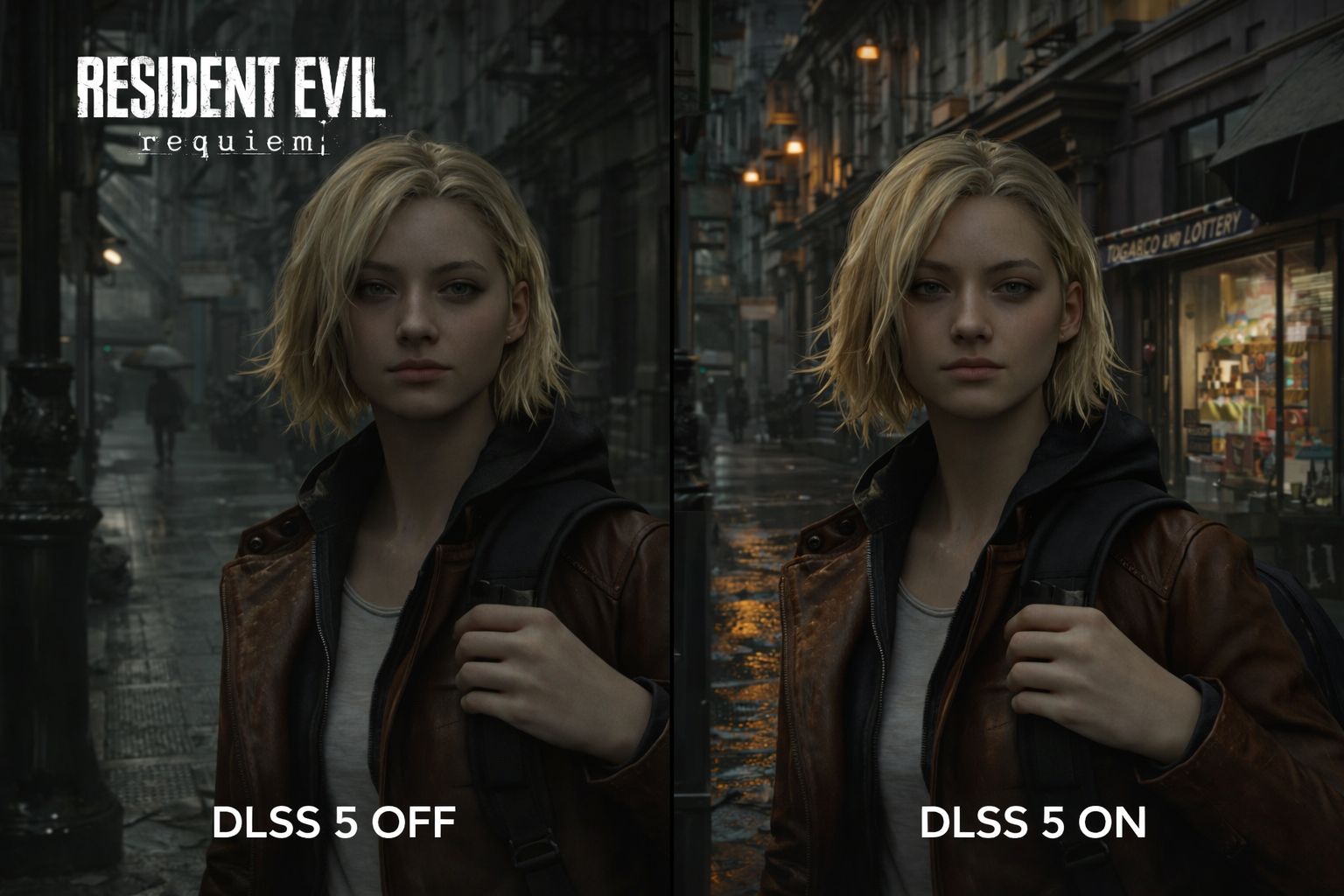
The engine now produces a simplified base image, which AI models then reconstruct and enhance. Missing detail is filled in, lighting is refined, and textures are sharpened based on learned patterns rather than explicit instructions. This approach significantly reduces rendering cost while increasing perceived visual quality. However, it also introduces a shift in authorship. The final image is no longer entirely crafted by developers, but partially interpreted by AI systems trained on vast datasets.
DLSS 5 Comparison in Resident Evil Requiem
Why Nvidia Is Pushing AI Rendering
Modern graphics have reached a point where traditional scaling is becoming increasingly inefficient. Higher resolutions, ray tracing, and expansive game worlds demand enormous computational power, even on high-end hardware. Maintaining performance while increasing visual fidelity has become one of the biggest challenges in game development.
Nvidia’s solution is to shift part of that burden away from traditional rendering and toward AI. At GTC 2026, the company positioned DLSS 5 as the next evolution of real-time graphics. Instead of calculating every visual element, the system predicts the final image based on learned behavior. This allows for more complex scenes and higher detail without the same performance cost, but it also changes the nature of how those visuals are produced.
The Trade-Off: Performance vs Control
The advantages of this approach are clear. DLSS 5 can deliver sharper images, better performance, and the potential for richer environments. However, these gains come with a trade-off that goes beyond technical considerations. AI does not simply reproduce what developers create. It interprets it, and that interpretation can introduce subtle differences in how a scene looks.
This creates a new layer between developers and players. While the overall image may appear more detailed, certain elements may not match the original artistic intent exactly. For some players, this difference is insignificant. For others, especially those who value visual authenticity, it raises concerns about how much control developers retain over the final result.
What This Means for Game Development
If DLSS 5 becomes widely adopted, it could significantly reshape development workflows. Studios may rely less on manually crafting every visual detail and instead focus on building systems that AI can enhance. This could reduce production time, lower costs, and allow developers to scale their projects more efficiently.
At the same time, it introduces a shift in creative responsibility. Developers define the framework and boundaries, while AI contributes to the final presentation. This changes the relationship between art and technology, potentially redefining how visual quality is achieved in modern games.
A Different Kind of Progress
DLSS 5 represents a different kind of technological progress. Instead of pushing traditional rendering to its limits, it introduces a hybrid approach where AI plays an active role in creating the final image. This opens the door to new possibilities, but also challenges long-standing assumptions about how graphics should work.
As this technology evolves, it may redefine expectations around visual fidelity. Players may begin to accept AI-generated enhancements as part of the standard experience, even if it means moving away from purely handcrafted visuals.
Conclusión
DLSS 5 is more than just a feature upgrade. It marks a turning point in real-time graphics, where AI becomes part of the creative pipeline rather than just a supporting tool. The technology offers clear benefits in performance and visual quality, but it also introduces new questions about control, authenticity, and the role of developers in shaping what players see.
The shift is already underway. The real question is not whether AI will influence game graphics, but how far that influence will go and whether players are ready to embrace it.
where AI helps define what games look like.




![CarX Street v1.15.0 (+5 Trainer) [xX_Morda_Xx]](https://618b31e8.delivery.rocketcdn.me/wp-content/uploads/2024/09/carx-street-1-464x276.jpg)

![CONTROL Resonant v1.0-v1.4.x+ (+26 Trainer) [FLiNG]](https://618b31e8.delivery.rocketcdn.me/wp-content/uploads/2026/09/CONTROL-Resonant-01-464x276.jpg)